
- This event has passed.
Abraham Gesner the Lure of the Rocks and a Burning Ambition– book launch
The debt and bad management that drove Abraham Gesner off his farm in Chipman Corner in 1825, became a stroke of luck and innovation. After leaving Kings County, he spent two years doing medical courses in London hospitals. In the great metropolis, he encountered the industrial revolution. Attending various lectures and demonstrations, he got his first whiff of the rapidly developing new sciences of chemistry, geology and natural history. When he later returned to Nova Scotia, he imitated procedures which he had observed while abroad and experimented with “cracking” coal to generate the tars, oils and gases which fueled the industrial revolution. In the process, he produced “kerosene” – an illuminating gas and an oil – which revolutionized artificial lighting and generated much industry.
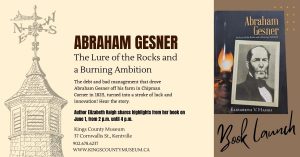 Author and retired professor, Elizabeth Haigh shares highlights from her book. Until 2006, she taught History of Science at St. Mary’s University, and was an adjunct professor of history at Dalhousie University in Halifax.
 imunify-bot-check