
Temporary Exhibits
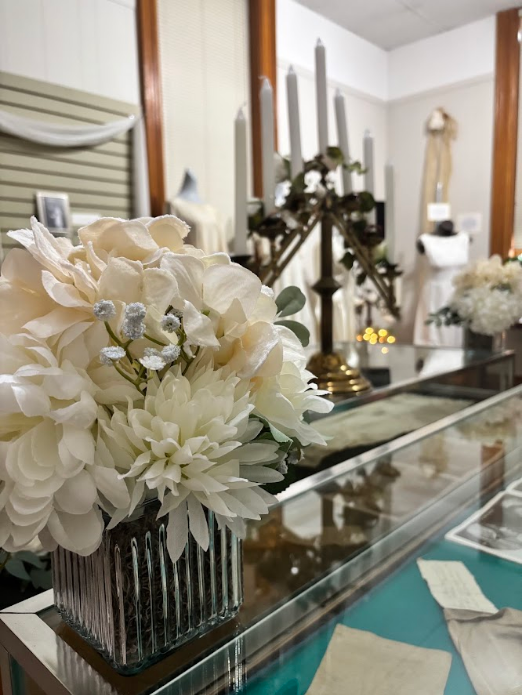
A Century of Love: A Wedding Exhibit
Step into a world of delicate lace, flowing silk, shimmering satin, and intricate beadwork through our newest exhibit, which brings the history of bridal fashion to life. Journey through wedding dresses from the turn of the century up to the 1980s, and discover how everything from the economic hardships of the wartime years to the Hollywood glamour of the Jazz Age has influenced fashion and tradition throughout time. Come learn the stories and social narratives woven into every gown, and see how each decade has its own unique flair!
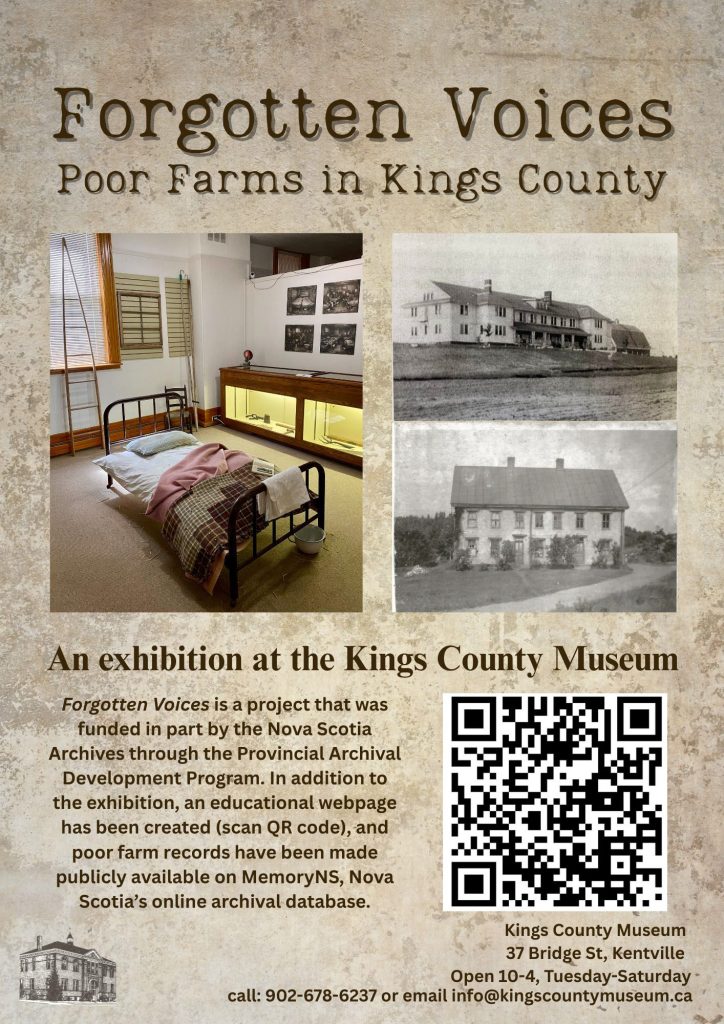
Forgotten Voices:Poor Farms in Kings County
Over the last several months, our curator Kaleigh has been working on a research project funded by the Provincial Archives Development Program. After many hours spent rooting through archives, sifting through historic documents, and traveling to local historic sites, “Forgotten Voices: Poor Farms in Kings County ” is now open to the public.
For those unfamiliar, poor farms were institutions created to house people experiencing poverty, disability, illness, old age, or other forms of social marginalization. Though they once existed in many communities throughout Nova Scotia, their stories are often overlooked or forgotten today. This project aims to explore not only the history of these institutions, but also the lives of the people who lived and worked within them.
“Forgotten Voices” is a multifaceted project that includes the development and launch of a new public exhibition here at the Kings County Museum, the identification and publication of archival records related to poor farms on MemoryNS, and the installation of QR codes at grave sites linking visitors to a new informational webpage about the history of these institutions. Additionally, Kaleigh has created educational materials and digital content designed to help hour to mingle, share stories and memories, and explore the exhibition.
Permanent Exhibits
The Bishop Clock
The Bishop clock was crafted in Horton Township in the late 1700s by John Bishop and given to his daughter, Ameila, upon her wedding to Charles Dickson, of Horton in 1772.
Since 1772, the Bishop Clock, a remarkable example of early Nova Scotian ingenuity and woodworking, has found itself in many different homes and, most recently, in Annapolis, Maryland where it was taken care of by descendants of John Bishop. The clock returned home to Nova Scotia in July 2025, accompanied by Stephen Sieracki, and found a new home at the Kings County Museum where it will be preserved for generations to come.
More about the Bishop clock
Watch 1772 Clock Comes Home on Youtube


Historic Courtroom
This courtroom was the site of many famous legal dramas during the past century, including bank robberies, cattle-rustling and murder.
Completely refurbished in 1981, the 4-1/2 foot high dado paneling in the courtroom has been hand grained to simulate oak. The process, carried out by Bradford Forsyth of Millville, Kings County, was begun by first stripping off the many layers of paint applied over the years. The trim and paneling was then covered with a base coat of white paint, followed by a coat of stain. The stain was “grained” with the skillful use of various pieces of cloth and metal combs resulting in the paneling taking on the appearance of natural grain.
Mr. Forsyth’s art work contains cleverly camouflaged images of animals in the pattern of the grain. Rabbits, bears, goats and fish are among the figures to be found in the beautifully refurbished woodwork.
New England Planters
In 1755 the Acadians were expelled from Acadia, and forced to leave their homes, livestock, and all their possessions behind. Three years later, in 1758, Governor Charles Lawrence issued a proclamation to the people of New England inviting them to settle the fertile Nova Scotian farmlands left vacant following the expulsion of the Acadians. By 1768, approximately 8000 New Englanders, known as the “Planters” had made the move.
To commemorate this history, the Kings County Museum in conjunction with Parks Canada has established a National Commemorative Exhibit to the New England Planters.

 imunify-bot-check